What’s new for 2025
The holidays are about creating warm memories—and lighting is the fastest way to set a welcoming tone. For 2025, the big shifts are bolder color mixes, cleaner repeating patterns, and smarter LED controls that let one roofline handle multiple looks all season.
- Bold color combos that still feel classic
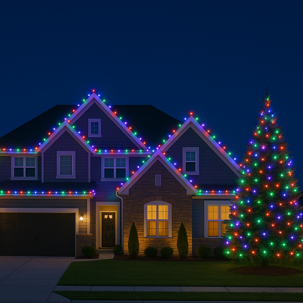
- Red + warm white remains the most requested “traditional but brighter” pairing, while blue + gold is trending on larger homes for an elegant, high-contrast look. Families continue to choose multi-color gradients for a playful, neighborhood-friendly vibe. Building these looks with LEDs cuts energy use dramatically versus older incandescent strings and reduces heat on foliage and siding.
- Patterns that highlight architecture
- Instead of outlining everything, the trend is to pick one or two architectural features and repeat a crisp pattern: a 2-red / 3-warm-white roofline alternation, evenly spaced peak accents, uniform “icicle” drops, or perfectly wrapped posts and small trees. Keep bulb spacing consistent and place any pattern breaks at natural transitions (e.g., at a downspout) so the design reads cleanly from the street.
- Smart lighting tech for “one setup, many looks”
- Modern controllers let you swap palettes for Christmas, New Year’s, and even game-day team colors without re-hanging lights. LEDs last much longer than incandescents and, paired with timers or dusk sensors, they keep displays consistent while managing energy automatically.
Safety & quality checklist
• Use certified products. Choose lights and controllers with a recognized safety mark (UL/ETL) and the correct outdoor/wet-location rating.
• Inspect and replace damaged gear. Look for cracked sockets, frayed wires, or loose connections and replace damaged strings rather than repairing in the field.
• Mind power and load limits. Follow the manufacturer’s limit on how many strings you can connect end-to-end; avoid overloading outlets or power taps (older incandescent sets are commonly limited to about three strings).
• Secure and protect. Fasten lights to solid supports, keep conductors off sharp edges, and use outdoor-rated extension cords and GFCI-protected outlets.
• Year-round strings. If you plan to leave lights up beyond the holidays, choose products evaluated for all-year use under the appropriate standard rather than seasonal-only sets.
Design tips for Boise-area homes
• Color temperature: Pair warm white (around 2700–3000K) with red/green for classic looks; use neutral/cool whites to sharpen blue & gold or icicle themes.
• Repetition wins: Pick a simple repeating unit (for example, “2 red / 3 warm white”) and carry it across the full roofline for a premium finish.
• Scale to distance: On tall two-story elevations, step up to C9 bulbs for visibility from the street; reserve mini-lights for shrubs, columns, and small trees.
• Controls: Add dusk-to-dawn or scheduled shut-off for energy savings and to keep displays consistent all season.
Eco & energy notes
LED holiday lights typically use far less energy and last far longer than incandescent sets—meaning fewer ladder trips and lower utility impact during peak months. Timers and daylight/motion controls compound the savings while keeping the display looking polished.
Community reminder
Be considerate of neighbors: aim light only where it’s needed, use the lowest level that still looks good, and avoid glare or spill into bedroom windows. Good lighting is as much about control as it is about color.
When to call a pro
Consider professional installation for steep roofs or high peaks, when you want cut-to-fit commercial-grade strands, or if you need smart-controller programming and clean, weather-safe power distribution for the whole season.
Bottom line for 2025
Bold color pairings + disciplined patterns + smart LEDs = a display that looks elevated, runs safer and cheaper, and adapts to every moment of the season.
Sources
• U.S. Department of Energy — “LED Lighting” (energy savings and longevity of LEDs). The Department of Energy's Energy.gov
• U.S. Department of Energy — “Lighting Choices to Save You Money” (LEDs for outdoor use, timers/daylight controls). The Department of Energy's Energy.gov
• U.S. Consumer Product Safety Commission — “Holiday Safety” (incandescent stringing limits, outlet overloading cautions). U.S. Consumer Product Safety Commission
• UL — “String Lights for All-Year Use—UL 588 Supplement SD” and UL 588 scope reference (year-round vs. seasonal product criteria). UL Solutions+1
• DarkSky — “Five Principles for Responsible Outdoor Lighting” (aim, control, and warm-color guidance to limit glare and spill). darksky.org