Rodents become much more visible around Boise and the Treasure Valley as nighttime temperatures drop. Food and water dry up outside, so mice and rats begin testing buildings for weak points and easy calories. Before you set traps or call for help, a good inspection can tell you what you’re dealing with (mouse vs. rat) and where they’re active.
First, a quick way to tell mouse from rat - by evidence, not sightings.
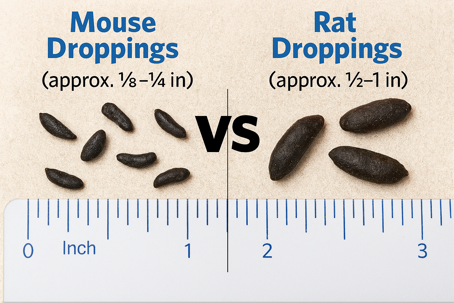
Start with any droppings or gnawing you can find. Mouse droppings are typically about ⅛–¼ inch long and pointed; rat droppings are larger (roof rat ≈ ½ inch, Norway rat ≈ ¾–1 inch). That size difference, paired with where you find them (low, near burrows vs. high, near rooflines), is often enough to point you in the right direction (Cornell CALS). Cornell CALS
Mice are the classic “squeeze-through-a-tiny-gap” offenders - if you can fit a pencil in an opening, assume a mouse can use it. Practical rule of thumb: mice exploit ~¼-inch gaps, and rats go bigger (and will enlarge edges by gnawing) (UC IPM). UC IPM
Outside: yard & landscape
Begin where food, cover, and water intersect - fruit trees, bird or chicken feeders, gardens, stacked materials, and drip lines. You’re looking for patterns, not one-off clues.
- Runways through mulch or turf that hug fences and walls, often with light rub marks where bodies brush a surface.
- Feeding sign on fallen fruit, garden produce, or pet food; roof rats in particular like fruit and travel along fences and branches to get it (UC IPM Rats). UC IPM
As you move toward the house, note anything that would shelter a rat burrow system - dense ivy/juniper, woodpiles, or clutter tucked near foundations. Norway rats prefer ground-level nesting and will place burrows near reliable food/water sources (UC IPM Rats). UC IPM
Near the foundation and along exterior walls
Now shift from the yard to the structure itself. If rodents are staging from outside, you’ll usually see a “story” along the bottom 12–18 inches of the building.
- Rub/grease marks on foundation or siding at repeat travel routes; look where walls meet hardscape and at utility penetrations.
- Chew-outs & shavings at door corners, garage weather-stripping, or around pipes - fresh wood or plastic crumbs = current activity.
- Openings at vents or gaps around lines; remember the size thresholds (≈¼ inch mice; rats need more room but simply make it by gnawing) (UC IPM). UC IPM
Outbuildings (sheds, shops, well houses)
Sheds and shops collect exactly what rodents want: shelter, warmth, and stored food. Do a slow clockwise sweep at eye level, then under benches and along the lowest shelves.
Paper/insulation nests tucked behind totes and small engines.
Food caches (pet food, seed, nuts) piled in corners or under equipment - classic sign of ongoing use (UC IPM Rats overview of feeding/nesting). UC IPM
Structural “bridges” to attics and soffits
If you’re finding evidence up high, think roof rats. They are agile climbers and routinely use branches, vines, cables, and conduit as highways to upper stories and roofs (UC IPM Rats). Trim back limb contact where possible and inspect gutters, soffits, and utility entry points for rub marks. UC IPM
Crawlspaces & attics
Inside the envelope, focus on where pipes, wires, and framing intersect - these are rodent freeways. Roof rats favor elevated routes (rafters/soffits), while Norway rats tend to stay low.
- Trails & smudges on joists and along mechanical runs; dust can help you see footprints/tail drags.
- Nests in insulation voids or near can lights; a persistent musky odor often accompanies a growing colony (UC IPM & general IPM guidance). UC IPM
Garages
Garages are “gateway” spaces - plenty of cover, frequent door openings, and stored foods.
- Droppings/urine speckling near water heaters, freezers, pet food bins, and along lower shelves.
- Chewed weather-stripping and light leaks at door bottoms and corners; fresh gnaw marks indicate active entry pressure (UC IPM House Mouse). UC IPM
Living areas & little-used rooms
Mice, especially, will work the edges of cluttered rooms and utility spaces at night. If pets fixate on an appliance void or a wall, they may be telling you where to look.
- Edge-running droppings behind couches, along baseboards, and under appliances (small, pointed = mouse).
- Rub marks around pipe chases and along baseboards; confirm with a quick “track patch” (light dusting of flour/talc) to see prints and tail drags by morning (general IPM practice; pair with species clues above from UC IPM/Cornell). Cornell CALS
Kitchens & food storage (pantries, cold rooms)
This is where evidence is easiest to read. Clean thoroughly once, then re-inspect; fresh sign within 24–72 hours means active pressure.
- Chewed packaging (paper/cardboard/thin plastic) and scattered kernels near the breach point.
- Kick-plate smears on lower cabinets where rodents squeeze through gaps.
- For safety, never dry-sweep droppings - wet cleanups only with proper ventilation and disinfectant per CDC guidance. CDC
What the pattern suggests
If you’re seeing burrows outdoors plus low wall rubs and activity at the foundation, suspect Norway rats. If the story is fruit/trees/vines, rubs and droppings up high, and noises above the ceiling, think roof rats. When the clues are small droppings, edge-running, and dime-sized gaps exploited around doors or utilities, you’re likely dealing with house mice (UC IPM summaries). UC IPM+1
What to document before service
Photos help a tech confirm species and choose the right control plan fast. Aim for:
- A close-up of droppings with a ruler or coin for scale.
- Any gnawing (include the surrounding material so size is clear).
- Suspected runways/rub marks, burrow entrances, and nests.
- A quick note of where each photo was taken (e.g., “north fence under lilac,” “attic near hatch”).
Safety note for cleanup
Ventilate first, then do wet cleaning of urine/droppings/nests with an EPA-registered disinfectant or a proper bleach solution - do not dry-sweep or vacuum. Wear gloves, bag waste, and wash hands after removing PPE (CDC). CDC
Sources
- Centers for Disease Control and Prevention (CDC). “How to Clean Up After Rodents.” Updated Apr 8, 2024. CDC
- UC Statewide IPM Program. Pest Notes: House Mouse (PDF, revised 2025). Entry-size thresholds and prevention. UC IPM
- UC Statewide IPM Program. Pest Notes: Rats (PDF, revised June 2024). Roof vs. Norway rat behavior, nesting, and inspection focus. UC IPM
- Cornell CALS - New York State IPM. “Mouse and Rat Biology and Behavior.” Droppings size and ID cues. Cornell CALS