Fall “Wall Huggers” in the Treasure Valley: Elm Seed Bugs & Boxelder Bugs
Field Guide
Elm seed bug (Arocatus melanocephalus)
• Color/markings: dark brown-black with rusty-orange edging on the wings.
• Behavior: piles up on south- and west-facing walls; emits a distinct odor when handled; numbers can be extreme in neighborhoods with lots of elms.
• In homes: slips into attics, wall voids, and around window frames to overwinter; may appear on sunny winter days at windows and lights.
Boxelder bug (Boisea trivittata)
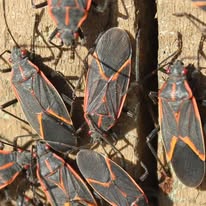
• Color/markings: black with bright red/orange wing margins.
• Behavior: gathers in massive clusters on warm, sunny walls, fences, and porches, especially near boxelder/maple/ash.
• In homes: moves through siding gaps, soffits, and foundation cracks to overwinter; can stain surfaces if crushed.
Surge Calendar
- July–August: Elm seed bug pressure builds first (peaks mid-to-late summer), especially near elms; early wall congregations begin.
- September–October: Boxelder bug numbers spike; both species concentrate on sunny siding and push indoors ahead of cold snaps.
- Winter warm-ups: Expect “surprise” sightings at windows/ceiling fixtures on mild afternoons—these are overwintering adults waking temporarily.
Entry Diagnostics
- Hairline siding seams, utility penetrations, and trim transitions.
- Attic vents/soffits without tight screening.
- Window/door weatherstripping that shows daylight.
- Foundation cracks and gaps at sill plates.
- Tip: Check the sunny sides first (south/west walls). That’s where clusters start and entry points usually concentrate.
Homeowner Playbook
- Seal + screen. Caulk siding seams; add backer rod where gaps are wide. Install or repair fine-mesh screens on attic and crawl vents. Replace worn weatherstripping.
- Vacuum, don’t crush. Use a vacuum (bagged if possible). Crushing can stain walls/curtains and release odor.
- Light management. Reduce night lighting on sunny façades or shift to warmer “bug” bulbs to attract fewer flying insects that feed spiders and draw invaders.
- Landscape spacing. Trim trees/shrubs off siding to cut the “ladder” onto warm walls.
- Expectations. These pests don’t reproduce indoors; the goal is to exclude and reduce—not to “erase” every bug on a warm fall afternoon.
Professional Program & Timing
- Seasonal exterior treatments (late Aug–Oct): Non-repellent or labeled residuals at siding, windows, door thresholds, and foundation lines, timed ahead of peak warm afternoons.
- Targeted void work: Dusting key voids (attic perimeters, wall/soffit spaces, utility chases—where label-permitted) to intercept overwintering adults.
- Follow-ups during migration weeks: Short intervals to refresh exposed areas and adjust to shifting sun-warmed hotspots.
- Exclusion checklist: Document and prioritize sealing fixes so next fall is easier.
Neighborhood Snapshots
- Eagle & river corridors: More elms → bigger elm seed bug swarms on warm afternoons.
- Meridian & Star (newer builds): Light-colored, sun-soaked elevations = ideal boxelder bug staging walls.
- Boise’s North End / older homes: Historic siding and trim gaps make indoor overwintering more likely without exclusion.
- Nampa & Caldwell: Open landscapes and wind exposure push waves onto west-facing walls; clusters can be dramatic on garages and fence lines.
Sources
- University of Idaho Extension — Managing Elm Seed Bugs around Your Home (ID identification, seasonality, exclusion): https://verso.uidaho.edu/esploro/outputs/report/Managing-Elm-Seed-Bugs-around-Your/996823134601851 Idaho Research Portal
- University of Idaho Extension — Managing Boxelder Bugs Around Your Home / Boxelder Bug: Nuisance Management for Homeowners: https://www.uidaho.edu/extension/publications/publication-detail?id=cis1208 and https://verso.uidaho.edu/esploro/outputs/report/Boxelder-Bug-Nuisance-Management-for-Homeowners/996822663801851 University of Idaho+1
- Utah State University Extension — Elm Seed Bug (facts & home invasion behavior): https://extension.usu.edu/pests/ipm/notes_orn/list-treeshrubs/elm-seed-bug.php and research page: https://extension.usu.edu/pests/research/elm-seed-bug.php Utah State University Extension+1
- Idaho State Department of Agriculture — Elm Seed Bug Fact Sheet (Idaho history; nuisance status; odor): https://static1.squarespace.com/static/564b8c9ae4b0459b2b8187a3/t/5a316677e2c4834e60f5f8c9/1513186937008/2014_ESB_Fact_Sheet.pdf Squarespace
- Pacific Northwest Pest Management Handbooks — Emerging Insect: Elm Seed Bug (regional distribution; introductions): https://pnwhandbooks.org/insect/emerging-insect-pests/emerging-insect/elm-seed-bug-2009 PNW Pest Management Handbooks
- U.S. EPA — Integrated Pest Management Toolkit (inspection, sealing, and non-chemical steps that pair with treatments): https://www.epa.gov/system/files/documents/2021-07/integrated-pest-management-toolkit-2021.pdf EPA