
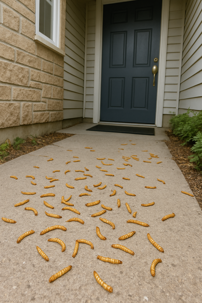
“Worms” in the House? Here’s What’s Really Going On
Lately, many Treasure Valley homeowners are calling with the same alarming report: “There are worms all over my floors, in my furniture, even inside light fixtures.” While unsettling, these aren’t earthworms. In most cases they’re the larvae of darkling beetles—commonly called mealworms—that have wandered from hidden areas into living spaces.
What they are (and aren’t)
Darkling beetles (family Tenebrionidae) lay eggs in protected places where there’s dry organic material (insulation dust, stored items, spilled pet food, old grain-based debris). The larvae are firm-bodied, yellowish-tan “worms” with a segmented shell and tiny legs near the head—very different from soft, legless earthworms. Some species are classic stored-product pests; others originate in attics, crawl spaces, garages, or outbuildings where they find warmth and food.
How they get indoors
When populations build, larvae wander in search of new food or a place to pupate. They frequently move through gaps around light fixtures, switch and outlet boxes, and other utility penetrations, or drop from attic spaces through unsealed can lights. From there it’s a short trip onto floors, furniture, or counters—especially during late summer and early fall when development peaks.
Why now?
Seasonal heat in attics and garages speeds up insect development. If there’s food availability (old bird seed or pet food, dusty cardboard, grain debris) plus warm shelter, you can see episodic “wanderers” showing up in living areas. It often looks like a sudden infestation even though the source has been building for weeks.
What We Do
1) Source-first inspection.
We check attics, crawl spaces, garages, pantries, and utility chases for food sources, harborage, and penetrations (around lights, pipes, and wires). We also inspect for other stored-product pests to rule out pantry involvement.
2) Targeted treatments where they live.
Depending on findings, this can include void and surface treatments in attics/crawl spaces, plus residual dusting in safe, label-permitted voids (fixture housings, switch boxes, insulation surfaces) to interrupt the life cycle. In living spaces, we rely on monitoring traps and pinpoint applications rather than broad indoor sprays.
3) Exclusion and cleanup.
We recommend sealing utility penetrations (can lights, electrical boxes, pipe/wire chases) and removing or containerizing attractants (old grain products, pet/bird feed, cardboard piles). This is critical to stop the steady trickle from hidden areas.
4) Follow-through.
Because some larvae may continue to emerge as they complete development, we set short-interval follow-ups (often weekly at first) to replace traps, reassess activity, and adjust treatments. Most homes are stabilized within 2–3 visits once the source is corrected; heavier activity or multiple sources can take longer.
What You Can Do Right Now
Today / Tomorrow
- Vacuum visible larvae and discard the bag to reduce odor and secondary pests.
- Empty/inspect pet food and bird seed containers; move anything grain-based into sealed bins.
- Note where you’re seeing them (rooms, under lights, near outlets) so the technician can trace likely penetrations.
This Week
- Declutter warm, undisturbed zones (garage shelving, attic access areas, closets).
- Seal easy gaps: outlet/switch plate gaskets, can-light trims (air-sealing kits), and obvious cracks around utility lines.
- Check stored items (cardboard boxes with old fabric, paper, or grains). Discard contaminated material and wipe shelves.
Going Forward
- Keep pet food in hard-sealed containers; store seldom-used grain products tightly or discard.
- Maintain attic/crawl access covers and consider broader air-sealing during weatherization projects (it helps comfort and pest prevention).
- If you continue to see daily activity indoors, schedule an interior service so we can treat the hidden source rather than just the strays.
Indoor vs. Outdoor Services - Why both may matter
Routine exterior perimeter services help with many crawling pests. But small flyers and occasional invaders (elm seed bugs, some darkling beetles) may bypass treated edges and enter through vents or penetrations. When you’re already seeing larvae inside, an interior, source-focused service is the right next step.
When to call us immediately
- You’re finding dozens per day or seeing them drop from light fixtures.
- You discover a pantry source (spilled grain, old seed, or heavily infested dry goods).
- Anyone in the home is sensitive to allergens and you want faster relief and odor control.
With a layered approach - source removal, void treatments where appropriate, sealing, and short-interval follow-ups—these infestations can be resolved and kept under control.
Sources
- Virginia Tech Extension — “Darkling Beetles and Mealworms” (ID, biology, where they occur in buildings)
- https://www.pubs.ext.vt.edu/ENTO/ENTO-283/ENTO-283.html
- Penn State Extension — “Dark and Yellow Mealworms” (life cycle, habitat, stored-product context)
- https://extension.psu.edu/dark-and-yellow-mealworms/
- University of Minnesota Extension — “Mealworm” (diagnosis page; where/when found in homes; nuisance vs. food pests)
- https://apps.extension.umn.edu/garden/diagnose/insect/indoor/beetles/large/mealworm.html
- EPA — “Integrated Pest Management in Buildings” (seal entry points; source-first IPM)
- https://www.epa.gov/sites/default/files/2015-11/documents/ipm_in_buildings.pdf
- Building America Solution Center — “Air-sealing around recessed light fixtures” (practical guidance that also blocks pest pathways)
- https://basc.pnnl.gov/resource-guides/air-sealing-recessed-light-fixtures-below-unconditioned-space
- StopPests IPM Toolkit (utility/pipe penetrations, sealing practices)
- https://www.stoppests.org/stoppests/assets/File/ipm-toolkit.pdf