Case Walkthrough: A Typical WDI/WDO Inspection in the Treasure Valley
Property: 1990s ranch style in Meridian with a vented crawl space and wood deck.
Why ordered: Buyer’s lender requested a wood-destroying evaluation during financing.
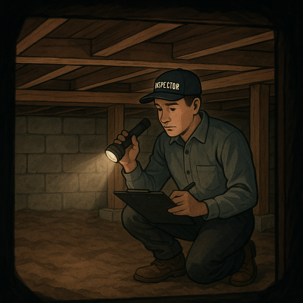
What happened: A licensed inspector reviewed the exterior foundation, garage, deck posts, and interior access points, then entered the crawl space. They found:
- No active termite tubes, but wood debris near the stem wall and sprinkler overspray wetting siding.
- Minor carpenter-ant frass under an old porch step.
- Soil graded slightly high at two spots (less than 6" clearance).
- Findings were recorded on the NPMA-33 real-estate report, with a note that if decay evidence had been present, a WDO Attachment would accompany the form (that attachment covers wood-decay fungi, which are outside the insect-only scope of the base report). npmapestworld.org+1
Outcome: The seller agreed to remove debris, adjust sprinklers, trim grade for proper clearance, and monitor the porch step; no structural repairs were needed. The lender accepted the report; the file moved forward.
Mini-FAQ
Q: What’s the difference between WDI and WDO?
A: WDI = wood-destroying insects (termites, carpenter ants, carpenter bees, and reinfesting wood-boring beetles). WDO = wood-destroying organisms, which expands scope to include wood-decay fungi. Real-estate inspections typically use the NPMA-33 (WDI); if decay must be reported, the WDO Attachment is added. npmapestworld.org+1
Q: Do we even have termites in southwest Idaho?
A: Yes—subterranean termites occur in Idaho and are well known for damaging wood near soil contact (fence posts, steps, sill plates, etc.). They stay hidden and can go unnoticed until damage is significant, which is why crawl spaces and low wood are priority areas. University of Idaho Library
Q: How long does an inspection take?
A: Typically 60–120 minutes, depending on home size, access (crawl space), and documentation needs. Reports used for loans follow the NPMA-33 format so agents, lenders, and buyers are aligned. npmapestworld.org
Q: Who is allowed to perform the inspection?
A: In Idaho, structural pest inspections and any follow-on treatments must be performed by properly licensed professionals overseen by the Idaho State Department of Agriculture (ISDA); you can verify license status via ISDA’s licensing pages. Idaho State Department of Agriculture+1
Homeowner Pre-Check (5 Things to Do Before an Inspection)
- Create clearance: Maintain ~6 inches between soil and wood siding; remove earth-to-wood contacts (form boards, step risers, buried fence rails). EPA
- Control moisture: Fix leaks; clean gutters; extend downspouts; adjust irrigation away from the foundation. EPA
- Declutter the perimeter: Remove scrap lumber and cellulose debris; stack firewood off the ground and away from the home. EPA
- Open access: Clear the hatch for crawl spaces/attics so the inspector can enter safely.
- Note prior concerns: Point out any past leaks, swarms, or repairs so they can be evaluated.
What a Lender-Ready Report Includes (NPMA-33 Essentials)
- Scope & limitations: Visual inspection of accessible areas; not technically exhaustive.
- Identification of WDI evidence: Termite mud tubes, frass, exit holes, damaged/voided wood, discarded wings.
- Conducive conditions: Earth-to-wood contact, moisture sources, ventilation/drainage issues, grade concerns.
- Diagrams & locations: Where evidence/conditions were observed.
- Recommendations: Monitoring, moisture correction, wood-to-soil separation, and treatments when warranted.
- For properties where decay fungi evidence is observed, the WDO Attachment accompanies the NPMA-33 to keep scope and responsibilities clear. npmapestworld.org+1
Choosing (and Verifying) Your Inspector in Idaho
- Check licensing: Confirm the company/inspector holds current ISDA credentials for structural pest work. ISDA’s portal provides license lookup and renewal status. Idaho State Department of Agriculture+1
- Confirm the form used: Ask that real-estate inspections be documented on NPMA-33, with the WDO Attachment if decay evidence is present. This avoids lender delays. npmapestworld.org
- Ask about local experience: Crawl-space construction, irrigation patterns, and seasonal moisture around foundations are Boise-area quirks that experienced inspectors know to check.
Sources
- NPMA — NPMA-33 WDI Report (scope) & WDO Attachment: https://www.npmapestworld.org/your-team-tools/npma-forms-npma3399a99b/npma-forms-information/ | https://www.npmapestworld.org/content-pages/technical-resources/wood-destroying-insect-wdi-information/wood-destroying-organism-attachment/ npmapestworld.org+1
- NPMA — Guidelines for Completing NPMA-33 (HUD/VA usage note): https://www.npmapestworld.org/content-pages/technical-resources/wood-destroying-insect-wdi-information/suggested-guidelines-for-completing-the-revised-npma-33-form/ npmapestworld.org
- EPA — Termites: How to Identify and Control Them (prevention and signs): https://www.epa.gov/safepestcontrol/termites-how-identify-and-control-them EPA
- University of Idaho Extension — Subterranean Termites (PDF) (Idaho context): https://objects.lib.uidaho.edu/uiext/uiext30870.pdf University of Idaho Library
- Idaho State Department of Agriculture — Licensing & Certification + License Lookup: https://agri.idaho.gov/pesticides/applicator-licensing-certification/ | https://applicatorlicensing.isda.idaho.gov/ Idaho State Department of Agriculture